
Your VicRoads drive test
Getting ready for test day
What to bring, what happens during the test, what the testing officer looks for, and how we help you walk in calm and drive out with your Ps.
Test day checklist
Tick these off in the week before your test. Your ticks are saved on this device.
0 of 11 ticked
Download the checklist poster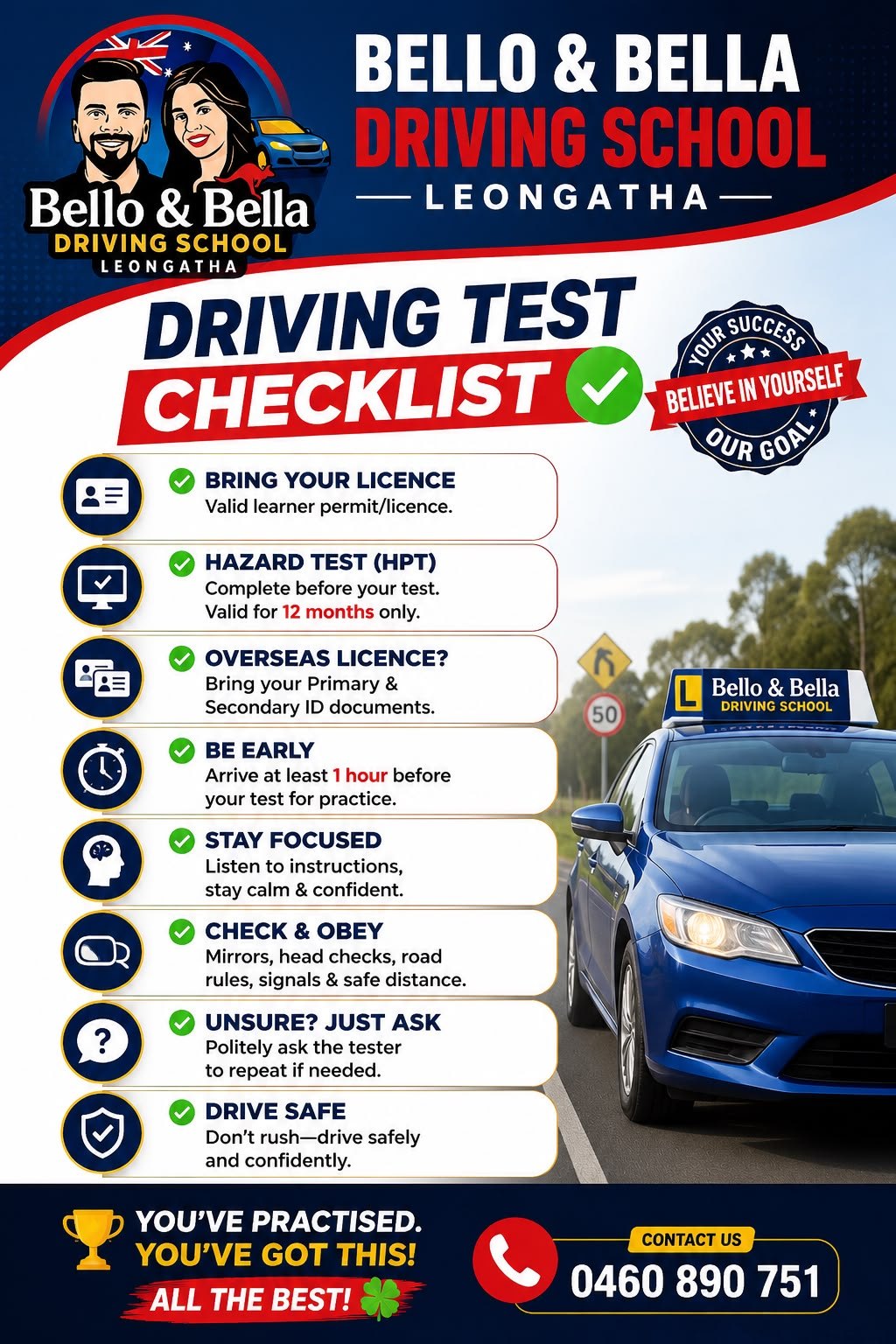
What happens on test day
The drive test takes about 30 minutes in total. With our test package, your day looks like this.
- 1
Warm-up lesson
We pick you up and drive the roads around the test office, so your nerves settle and the area feels familiar.
- 2
Check-in at VicRoads
You finish a few forms at the counter, then walk out to the car with the testing officer. VicRoads doesn't supply cars, so you'll drive our dual-control car.
- 3
Pre-drive check
Before you move off, the testing officer asks you to show that the car's controls work. See the full list below.
- 4
Stage one: 5 to 10 minutes
Quieter streets and less challenging traffic. You'll turn left and right, change lanes and do a reverse park or three-point turn. Then you pull over and the officer adds up your score. Pass, and you go on to stage two.
- 5
Stage two: about 20 minutes
Busier roads and a wider range of traffic: intersections, lane changes, merging, and straight and curved roads. Everything from stage one is still assessed.
- 6
Your result
Back at the VicRoads office, the officer tells you whether you passed and what to work on. If it wasn't your day, that feedback shapes your next lessons with us.
The pre-drive check
Sitting in the driver's seat, you show the testing officer that each control works, one at a time. If the brake lights or any of these don't work, the test may not go ahead. Your headlights stay on low beam for the whole test.
What you'll be asked to do
- 1Turn indicators, left and right
- 2Brake lights (the officer checks from behind)
- 3Horn
- 4Headlights, high and low beam
- 5Hazard lights on and off
- 6Windscreen washers and wipers
- 7Point out the handbrake or park brake
- 8Point out (don't switch on) the front and rear demisters
- 9Start the engine
What the testing officer looks for
You earn points by showing these safe driving habits the whole way round.
- Observation
- Look well ahead, and use your mirrors and head checks, especially when turning, slowing, stopping, changing lanes and joining or leaving traffic.
- Signals
- Indicate for at least 3 seconds before turning, changing lanes or diverging, and at least 5 seconds before pulling out from the kerb.
- Gap selection
- Take the first safe gap when joining traffic, merging or pulling out, so no one has to brake or swerve for you and no one is kept waiting.
- Speed
- Never over the limit. Going even 5 km/h over raises your crash risk. Keep close to the limit when it's safe, and slow down for the conditions.
- Following distance
- At least two seconds behind the vehicle in front, and more in poor conditions.
- Lane position
- Pick the right lane, steer a smooth path, stay fully inside your lane and keep a safe space from parked cars.
- Stop position
- At stop signs, lights and crossings, stop close to the line but not over it.
- Reverse parking
- Signal, check behind, then park near the kerb with a safe gap to the car in front, and move off again with a signal and a safe gap.
- Three-point turn
- Used when there's nowhere to park. Look before and during the turn, don't touch the kerb, and don't drive onto private property (a driveway is fine).
- Control
- Smooth acceleration and braking. In a manual, no stalling, smooth clutch and gears, and no coasting in neutral or with the clutch down for more than 50 metres.
Mistakes that fail the test
The test stops straight away if you:
- hit another vehicle, or mount the kerb while driving
- go 5 km/h or more over the speed limit, or any amount over it for 5 seconds or longer
- go over the limit in a school zone while it's operating
- fail to give way, signal or check, so someone else has to act to avoid a crash
- stop in a dangerous position
- drive through a stop sign or a red light
- disobey the testing officer or the police
- need your instructor or the officer to help you, by word or by touch
- do anything else that creates an unsafe situation.
These are critical errors. Too many and you fail:
- driving too slowly for the conditions, or not moving off when it's safe at lights, stop or give way signs
- not looking for other road users when you should (even if no one had to react)
- not signalling when you need to
- blocking a pedestrian crossing (with no pedestrians affected)
- one wheel mounting the kerb while parking or leaving a park
- stalling the car
- slowing down at a stop sign without stopping completely
- anything else potentially unsafe that doesn't put anyone at immediate risk.
Using your own car
The easy option is our dual-control car, which meets every rule. If you bring your own, it must be registered, roadworthy and clean, with mirrors on both sides, a working windscreen demister (and rear demister if fitted), a seatbelt for everyone, heating or cooling to stay comfortable, L plates, the original speedometer where the officer can see it, and headlights that can stay on low beam. It needs a centrally mounted handbrake the front passenger can reach (not needed in a dual-control car with an instructor), and a door beside every seat. Cars with an electric or foot park brake can't be used for solo tests. Want a manual licence? Test in a manual car. Speed warnings, cruise control and navigation must be off; parking sensors and reversing cameras can stay on. A dual-control car must have working buzzers or pedal covers.
How to give yourself the best chance
- Get your hours in. At least 120 hours, in all sorts of conditions: at night, in the wet and at different speed limits.
- Watch the speed signs. Know the limit at every moment, especially in 40 km/h school and roadwork zones.
- Stop means stop. A full stop at stop signs and stop lines, then look before moving off.
- Make your observation obvious. Turn your head before changing lanes, merging or pulling out, so the officer sees you looking.
- Practise the manoeuvres. Reverse parking and three-point turns, until they're smooth and unhurried.
- Know the area. A drive around the test office beforehand makes the roads feel familiar.
This guide is based on VicRoads' brochure What you need to know about your Drive Test. Rules change, so check the drive test page on the Transport Victoria website before your test, or call VicRoads on 13 11 71.
How many lessons before your test?
A rough guide. After your first lesson we'll tell you honestly how ready you are.
- Finished your 120 hours
- 2 to 4 lessons, then the test package
- Overseas licence holder, already driving here
- 1 to 3 lessons, then the test package
- Still building your hours
- Regular lessons alongside your supervised driving
- Nervous, or returning after a break
- Start with a nervous driver lesson
Driving test questions
How long is the drive test?
About 30 minutes: the pre-drive check, 5 to 10 minutes of stage one, then about 20 minutes of stage two.
Who will be in the car?
A VicRoads testing officer. Sometimes a second officer comes along for training; they don't affect your result. Your instructor may sit in the front passenger seat in a dual-control car, but can't talk to you or help during the test.
Can I use your car for the test?
Yes. Our driving test package includes a warm-up lesson and the use of our dual-control car for the test. VicRoads doesn't supply cars.
Do I have to pass the Hazard Perception Test first?
Yes. You must pass it before your drive test, and then pass the drive test within 12 months.
How do I book the test itself?
With VicRoads, online or by calling 13 11 71. You pay the VicRoads fee directly; our package covers the lesson and the car.
What happens after I pass?
You get your probationary licence: red P plates (P1) for one year, then green P plates (P2) for three years.
What if I don't pass?
The testing officer tells you what needs work. We'll go through that feedback with you, practise those areas and get you ready to book again.
Ready for your Ps?
Book the driving test package: a warm-up lesson on the day and our car for the test.